
List of Common Misconceptions (Radon's edition).
Wikipedia's List of Common Misconceptions is a required read. Sorry to just blurt that out, but it's true.
Many people say that they want to read something that changes their point of view or even their life. I don't know if I can promise that, but this would probably be my best bet to do that. For those too lazy to click, it's a massive list of statements that go against the commonly held belief about many things. It's a very quick and simple way to inform someone on a subject - just quickly mention to them all the ways pop culture gets it wrong, and you've moved them closer to the truth.
And then, like normal people do, I began self-inserting my own corrections to misconceptions.
Just start rattling them off, then boom. New article.
Video Games.
The original Xbox "Duke" controller originated from an issue with parts available for manufactoring, and thus its infamously bulky size was not an intentional design element.
The term "Xbox 1" or "Xbox One" was already in use before 2013. It was used by community members to refer to what is now called the "original Xbox", in a very similar way to how the original Playstation is referred to as the "Playstation 1".
The Dreamcast was not the only console that had its memory cards plug into the controllers - The original Xbox and Nintendo 64 also did this, although in both cases they were sold seperately and not commonly used.
The Sega Genesis' primary competitor on release was the NES, not the SNES. The latter wouldn't release in North America until two years after the Genesis, which many believe is why the Genesis captured the market so aggressively.
CD-i was a standard, like DVD, not a specific console or machine. This is why it came in many variants from many manufacturers, and were often marketed as regular CD players with CD-i capabilites rather than the largely anarchonistic term "CD-i Consoles". The same is true for 3DO.
CD-i was not intended to be a platform for gaming - The pivot to it was a desparate attempt to recoup losses with the available hardware after it failed to sell well while performing its primary purposes: Interactive educational and training software, karaoke, and visual guides.
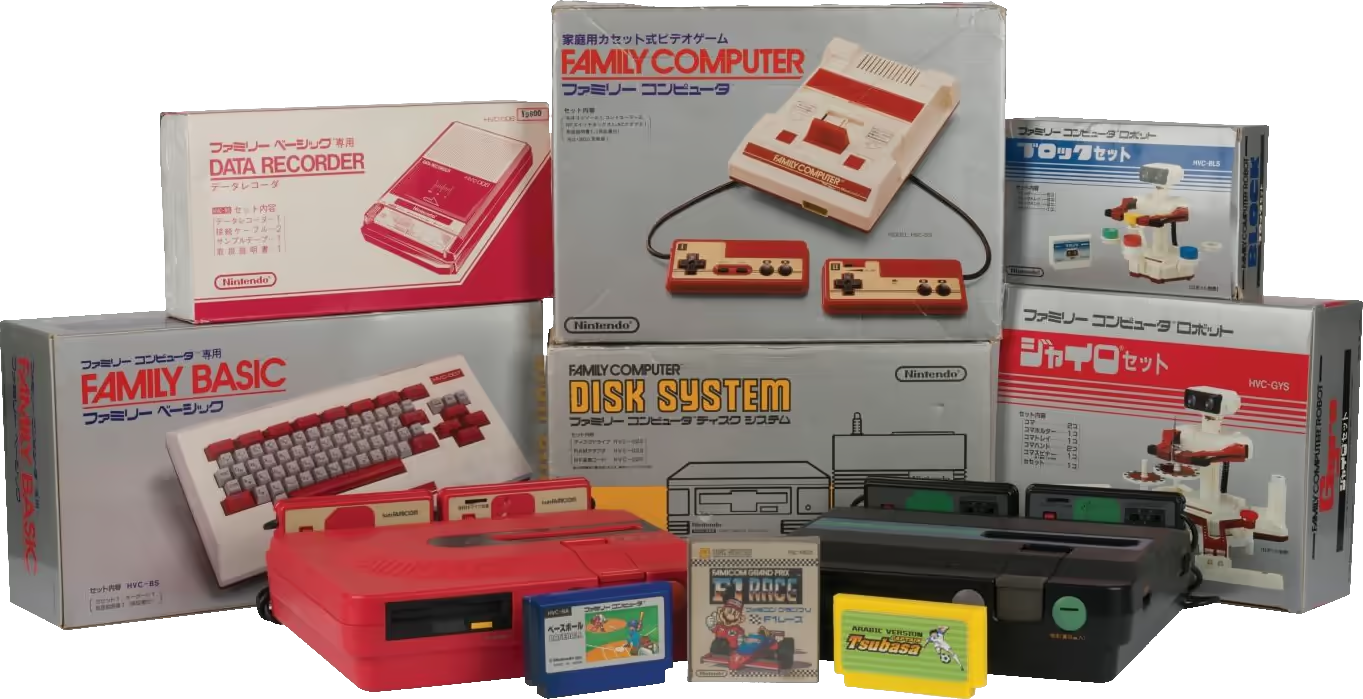
The Famicom was much more like a Family Computer (hence the name) than most people realize - It got expansions such as a casette reader and writer, a floppy disk drive (The Famicom Disk System), and a full keyboard with programming capability in the BASIC programming language.
Nintendo's decision to use cartridges instead of CDs for the Nintendo 64 was primarily based on loading performance for games, not in physical durability, manufactoring familiarity, or anti-piracy. This is also why the 64DD chose to use magnetic Zip-drive style disks - they could be read faster than optical media.
The 64DD also chose magnetic disks because that made it one of the very few consoles that could write to any part of its own disks/cartriges - they were effectively large floppy disks with no write-protection tab. This was actually the primary selling point of the 64DD, and is why almost all of its exclusives had to do with creativity or saving large amounts of user-created content.
Up until the Playstation 5 (and the Wii with Nintendo specifically), the parts and assembly of a console often costed more than it sold for, meaning that money was lost with each console sold. Console manufacturers made up for their losses by charging royalties on all games sold on it, which is why games tend to be more expensive on console.
None of the Nintendo-licensed CD-i games significantly impacted Nintendo's view of third-party licensing of their properties. The games were not heavily publisized and did not sell well, masking their quality to the public. The concept of them being an embarrassment to Nintendo is anachronistic, as they were not widely known about until the mid 2000s.

Puyo Puyo is actually a puzzle spinoff to a different series, Mado Monogatari, much in the same way that Mario Tennis is a spinoff to Mario.
Super Mario Bros. 2 was orignially concieved of as a Super Mario Bros. game. While it was converted to a promotional product for Fuji Television entitled "Yume Kojo: Doki Doki Panic" then converted back again, the original concept was still for a game in the series, and neither was it merely a reskin - many gameplay changes were made between the two games.
In addition, the prototype that would later become Doki Doki Panic was conceived of and planned to release after Super Mario Bros. 2 in Japan (Also known as "The Lost Levels"), meaning that they were actually developing what they believed to be Super Mario Bros. 3 at the time.
Cheat Codes were not discovered by random chance or input, even in the 1990s. They would either be discovered by data miners, or far more commonly, the developers themselves would distribute them to magazine writers.
Rapid availability of an emulator for a console soon after its release is not a new phenomenon; The first playable Nintendo 64 emulator, UltraHLE, came out in 1999, only 3 years after the N64 itself released.
Many releases on Nintendo consoles are incorrectly attributed with Nintendo having "made" them, therefore making them "first-party" titles, when they often acted only in a publishing and advisory role and don't even own said developer. Such examples include:
- All Kirby games are developed by HAL Laboratories. The rights remain with them, meaning Kirby is not a Nintendo character.
- Super Smash Bros. (1999) was developed by HAL Laboratories, and later Bandai-Namco for Smash 4 and Ultimate.
- All Paper Mario, Fire Emblem, WarioWare, and Advance Wars games are developed by Intelligent Systems.
- All "Mario & Luigi" games were developed by AlphaDream.
- All Mario Party games were developed by Hudson Soft until 2007.
The Sonic CD opening doesn't look like what you probably think it does. To this day, a YouTube search for "Sonic CD US Opening" shows the raw animatic rip from Toei included in Sonic Mega Collection from the Gamecube. This is what the opening actually looks like on the Sega CD:
Computer Science.
Microsoft did not skip the number "9" in it's numbering from Windows 8 to Windows 10 due to compatability concerns of programs checking for "Windows 9x". Skipping to 10 was done for marketing reasons, as 10 was a two-digit number that stood out more and helped to distance the new release from Windows 8 and Windows 7.

Turing completeness only refers to the ability of some processor to complete any concievable computation (via simulating any other system), not any concievable task. It does not imply that it is capable of doing anything, as such systems are often still bounded by hardware limitations or cannot access everything needed. As an example, although Redstone in Minecraft is Turing-complete, it is not possible to construct a working HTTP webserver with it that can interface with modern web browsers without extensive third-party software or modifications, as it cannot directly open ports for communication (barring having some other means of communicating with it).
Conway's Game of Life is intended as a game for demonstrating Mathematics and Computer Science, not Biology or Darwinian Evolution. It was not designed to implement any actual growth patterns or life-cycles of real-life organisms.
Data breaches are often not discovered to have happened until months after the data was leaked, and sometimes not until said data starts appearing for sale on the Internet. Server administrators attempting to shut down access to real-time hands-on-keyboard activity from an attacker as often depicted in media is extremely rare.
Military.
Deploying flares from an aircraft doesn't guarantee that an infrared guided missile will follow them. Many missiles built since the late 70s have IRCCM (Infrared Counter-Counter Measures), which can make flares less effective.

Radar on combat aircraft is not a 360-degree circular overhead view of targets around them. Most modern combat aircraft designed for air-to-air combat only have a 60-degree field of view pointing towards the front, and cannot search all altitudes at the same time.
Stealth aircraft refers to their stealthy nature from the point of view of radar - they are often just as loud and physically visible across all other wavelengths of light as the non-stealth aircraft they replaced.
Modern submarines almost never "ping" sonar continuously to locate ships as seen in popular media - The vast majority of their detection and identification capabilites comes from Passive Sonar, which does not emit anything. Pinging with Active Sonar would give away the presence and rough location of the submarine.
Many different military vehicles, such as the M1 Abrams and the Mi-24 Hind, are actually assymetrical despite appearing to be mostly symmetrical. This may be due to depictions of them in media not modelling this.

Three-quarters of F-35s in service do not have vertical takeoff and landing capability, as only the "B" variant of the F-35 includes the shaft-driven lift fan and swivel nozzle necessary. The variant is only operated by the Marines.
The term "casualty" only refers to any person who can't participate in combat again - This means that it actually does not necessarily imply death, as it also includes the injured, sick, and mentally unwell, those captured and taken prisoner, those missing in action, those who have deserted, and those who object to returning to the front lines.
History.
Ancient peoples did not see history and technology like we do. They believed that technology as it existed for them was how it always was, and always would be. The vast majority did not believe in an endless climb of progress from one "age" to the next.
Medieval Europe had many people who were not knowledgable about Christianity, or dedicated to it. While being Christian was an important social aspect, having many people not have knowledge of it's tenants despite claiming to be part of it was common like it is today.
The "early church" in Christianity was not unified or homogeneous, and in fact had far more diversity in thought, divisions, and "heresies" than today's Christianity.
In 1900, 38 percent of cars in the United States were electric cars. EVs shared market share with gas and steam powered cars in the early 1900s until significant improvements in internal combustion engines and the demands of road trips greatly reduced their use.
Conclusion.
Highly recommend everyone make their own. Come on, you have to have come up with some of your own while reading.
Also, maybe some of those weren't very common misconceptions.
At all.